Survival Scientists – Living Things in Challenging Environments
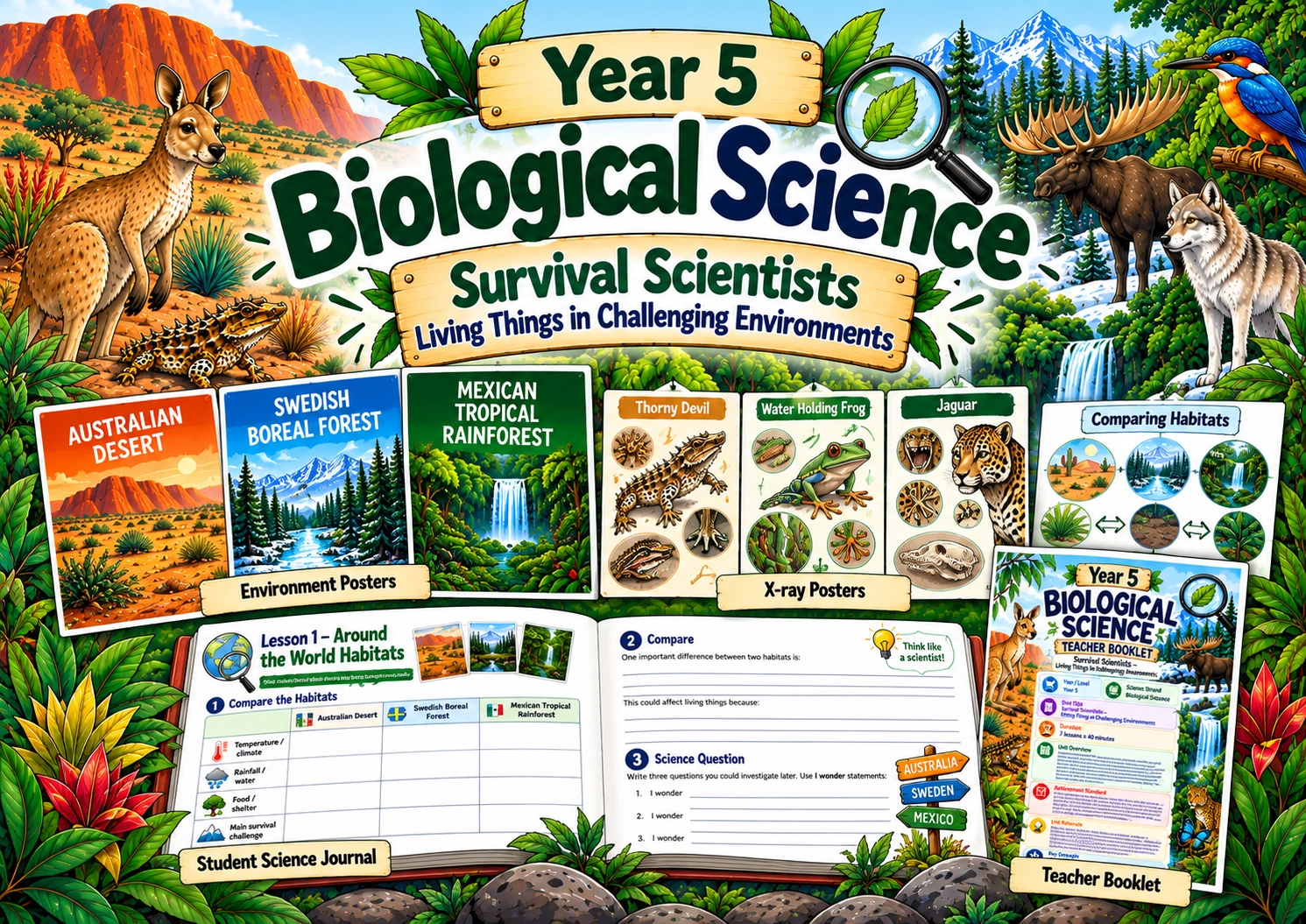
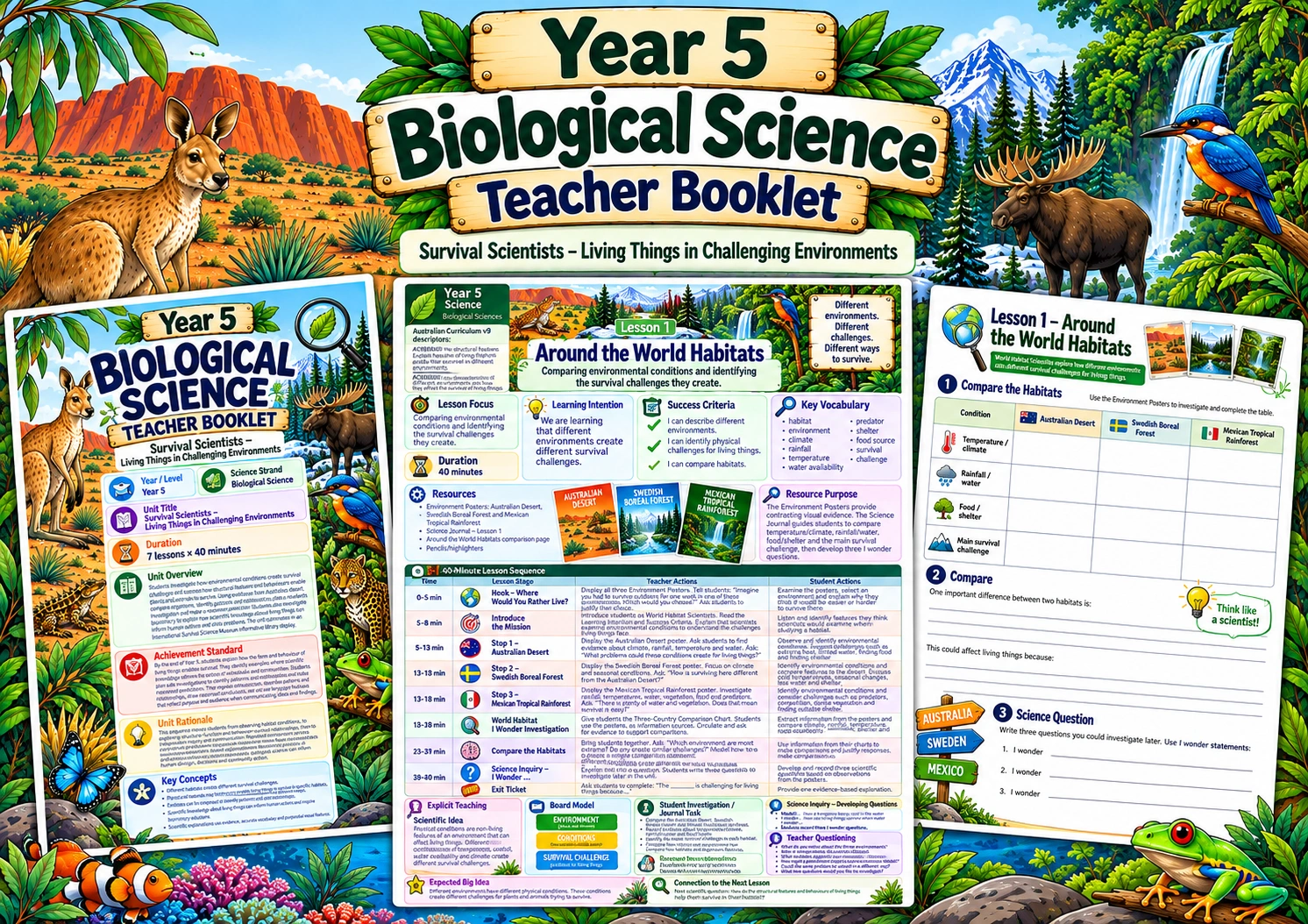
Year 5 Biological Science Unit Plan
Students investigate how environmental conditions create survival challenges and examine how structural features and behaviours enable plants and animals to survive. Using evidence from Australian desert, Swedish boreal forest and Mexican tropical rainforest habitats, students compare organisms, identify patterns and relationships, plan a research investigation and make a reasoned prediction. Students also investigate biomimicry to explain how scientific knowledge about living things can inform human actions and solve problems. The unit culminates in an International Survival Science Museum informative library display.
Year 5 Biological Science Teacher Journal and Student Journal PowerPoint
Using the Teacher Booklet and Journal PowerPoint
Use the Teacher Booklet as your guide for each lesson, with the learning intention, success criteria, vocabulary, explicit teaching, questioning, investigations and suggested lesson sequence provided to support instruction.
Display the accompanying Journal PowerPoint as a visual teaching tool when students are ready to complete their journal work. The slides mirror the student journal pages, allowing teachers to model each task, explain what is expected, discuss questions as a class and demonstrate how to record responses before students work independently.
This keeps the PowerPoint purposeful and low-stimulus — supporting teacher-led instruction rather than driving the lesson step by step.
Year 5 Biological Science Student Journal
The Student Science Journal guides students through each lesson and provides a structured place to record observations, compare evidence, develop questions, make predictions and explain scientific thinking. Use the journal alongside the Environment, X-ray and Comparison Posters to support investigations rather than as a stand-alone worksheet. Across the unit, students build on their learning from lesson to lesson, with their completed journal becoming an important source of evidence for the Survival Scientist Investigation and final International Survival Science Museum assessment.
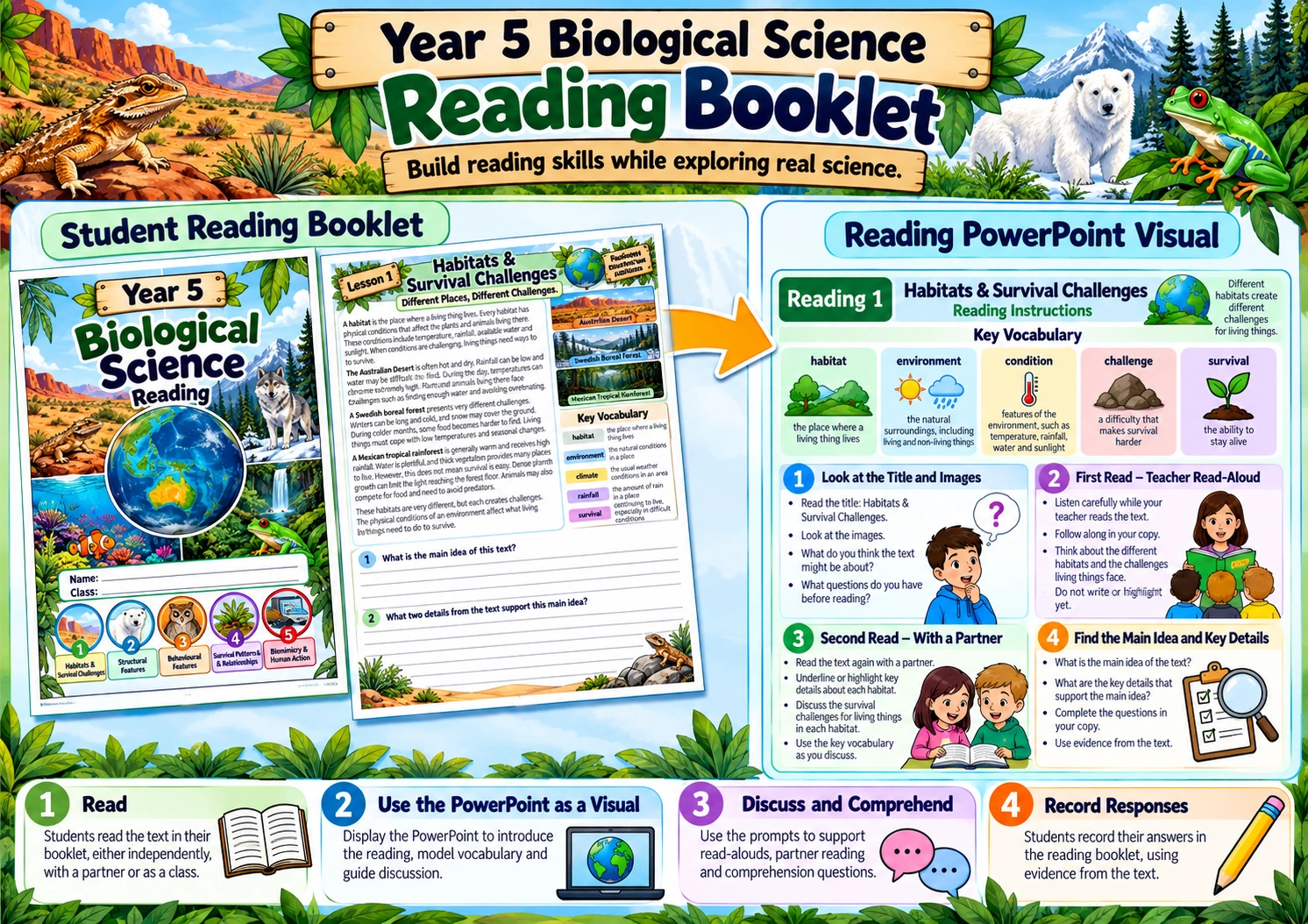
Year 5 Biological Science Reading Booklet
Use the Year 5 Biological Science Reading Booklet to reinforce science concepts while developing reading comprehension and scientific vocabulary.
Use the accompanying Reading PowerPoint as a visual to support each reading, helping teachers introduce vocabulary, guide discussion and explain the comprehension tasks while students follow along in their booklet.
Year 5 Biological Science Environmental Posters
These Year 5 Biological Science posters support the lesson sequence by helping students compare habitats, investigate survival challenges, explore structural features and behaviours, and gather evidence for their research and assessment.
Structural Features and X-ray Posters
These Structural Feature and X-ray Posters support the Year 5 Biological Science lessons by helping students investigate the external and internal features of plants and animals and explain how these structures help organisms survive in different environments. Students can use the posters to compare organisms, identify survival features and gather scientific evidence for their investigation and assessment.
Year 5 Biological Science Poster PowerPoint
Use the Poster PowerPoint as a whole-class visual throughout the unit to introduce concepts, model scientific thinking and support discussion and investigation. Display the relevant posters during explicit teaching and questioning, then keep them visible while students complete their Science Journal activities. The visuals allow students to closely examine habitats, structural features and behaviours, compare evidence across environments, and refer back to key scientific information without relying on text-heavy, step-by-step PowerPoints.